Postmaster on the Green: The Real Life Story Behind Louis Comfort Tiffany’s “Fuller’s Country Store”
It’s a crisp morning in 1872 in Norwich, Connecticut, and the bustling post-war manufacturing hub is fully alive. Along the river, the heavy thrum of textile mills, paper manufacturers, and iron foundries echoes through the streets. Locals crowd the cobblestone sidewalks, dodging horse-drawn delivery wagons heading toward the busy train depot. Women in Victorian skirts swap news on their way to the public squares, while merchants open their shops for the day’s trade. It is a vibrant community where New England tradition meets industrial commerce, setting a lively stage for the everyday interactions of its residents.
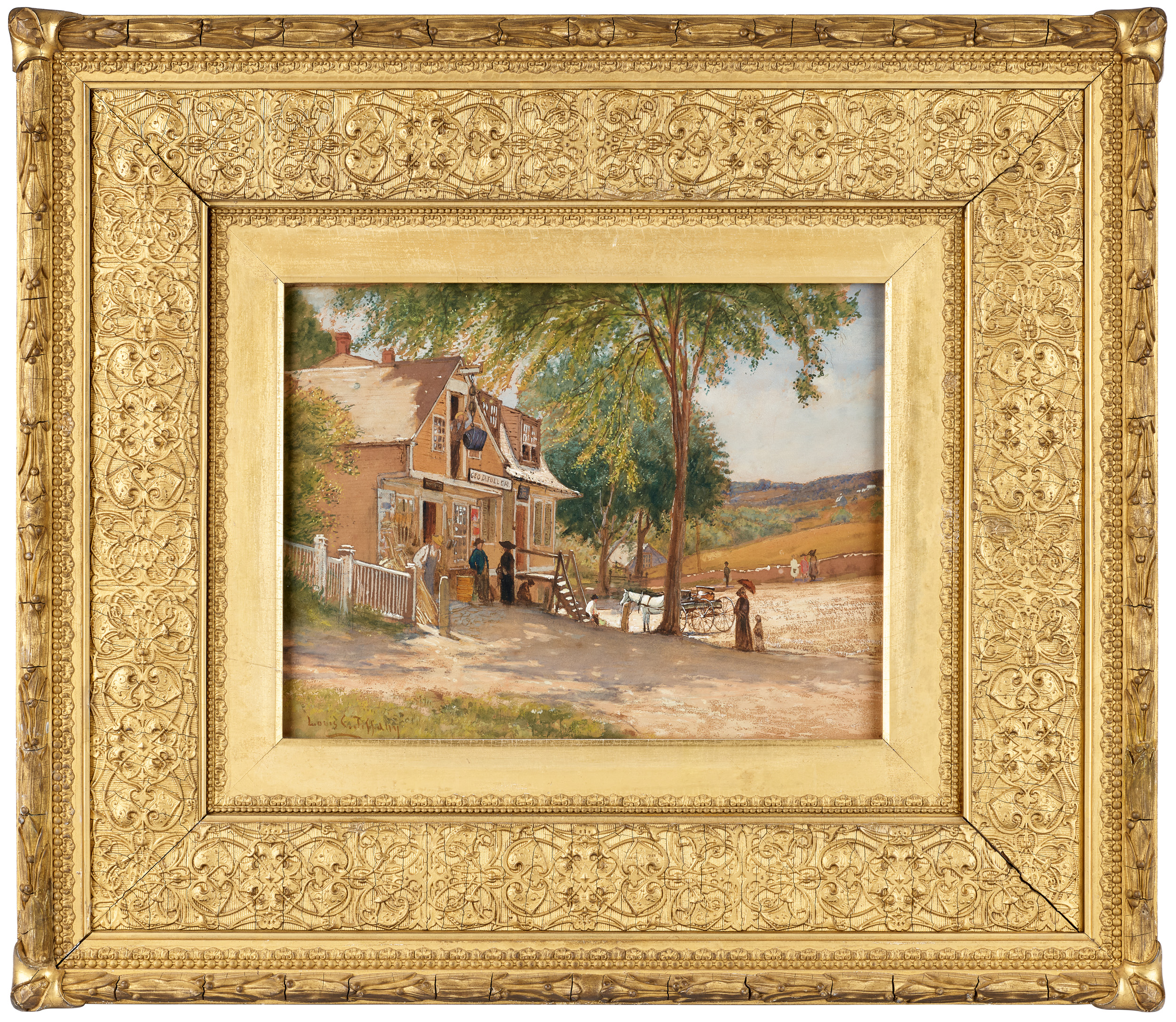
Foremost among these local businesspeople was George D. Fuller, whose dry goods store served as a vital community hub where locals gossiped about local politics while buying their daily rations. It was this specific storefront that caught the eye of an iconic American artist. In his evocative watercolor, Fuller’s Country Store, Norwich, Connecticut, Louis Comfort Tiffany captures the building’s weathered facade and historical presence. Though Tiffany is globally renowned for his later work in leaded glass, this painting highlights his incredible early talent as a watercolorist, preserving a quiet moment of Norwich’s post-wartime history forever.
Tiffany came from a wealthy family and was expected to take over the famous Tiffany & Co. business but opted to pursue independent artistic endeavors. His father bankrolled Tiffany’s budding art pursuits including paying for him to attend the National Academy of Design where he studied under landscape painter Samuel Colman. Although he focused primarily on painting and sketching throughout the 1870s and 1880s before shifting his career entirely to glassmaking, he continued to paint recreationally for the remainder of his life.
In 1872, Louis Comfort Tiffany married Mary Woodbridge Goddard. They met in Norwich during one of the many trips the Tiffanys took to visit family in the area. Tiffany wandered the streets of the quaint but industrious town capturing the architecture and daily life in sketches and watercolors. The painting “Fuller’s Country Store, Norwich Connecticut” is an exceptional example and perhaps the only known rendering of the building (which no longer stands) maintained by George Denison Fuller.
In an 1870 census report, Fuller was registered as a dry goods grocer, but his professional life was far more diverse. As was common practice in a small 19th century town, Fuller wasn’t just a shop keeper. It is widely reported that he acted as Postmaster, Constable, weigher, wood measurer, treasurer for the local school district, insurance agent, tax collector, and he even sold railroad tickets out of his shop. Imagine stepping into Fuller’s store: the smell of coffee beans fills the air, bolts of fabric lined up waiting to be turned into garments, household linens and quilts, mail cubbies situated on the wall, and the rustling sound of envelopes being opened. If you needed fire insurance, needed to pay a tax bill, or needed to secure passage on the local rail line, you had to lean over the counter and talk to George. As the appointed local agent for the railroad, Fuller was the literal gatekeeper of news, goods, and services for the entire historic district.
In Fuller’s Country Store, Louis Comfort Tiffany elevates an ordinary Norwich street corner into a vivid portrait of community life. Rather than focusing on prominent citizens or notable events, Tiffany captures the everyday interactions that defined small-town Connecticut in the late nineteenth century. The store itself serves as the focal point of the composition, drawing together neighbors, travelers, and local residents.
Rarely does a painting combine artistic significance, regional history, and everyday American charm as successfully as Fuller’s Country Store. This work captures a disappearing way of life while offering collectors a tangible connection to one of the most influential American artists of the nineteenth century. Its intimate scale, engaging subject matter, and strong provenance within Tiffany’s Connecticut period make it a compelling acquisition for both seasoned collectors and institutions alike.
-By Erika Lombardo
Sources:
Hathitrust.org
Dailyartmagazine.com
Morsemuseum.org
Americancraftcouncil.org
Ancestry.com
Archive.org
Iconicnorwich.org